Cart
0
Sign up and get 10$ off your order
Expected delivery
1-3 days
You may also like


Danish Company

TL;DR:
- Modern camping tech, such as inflatable tents and LiFePO4 batteries, significantly enhances convenience and setup speed. Dedicated navigation devices and multi-function tools improve safety and comfort in remote, cold conditions while maintaining portability. Choosing focused, high-quality gear tailored to your needs creates a smoother, more enjoyable outdoor experience.
There’s a stubborn myth that “real” camping means suffering through tangled tent poles at midnight, soggy boots by morning, and a dead phone by noon. That myth is getting thoroughly dismantled by a new wave of camping convenience tech that turns genuinely painful outdoor problems into non-issues. This explainer covers the gear categories reshaping how tech-savvy campers set up shelters, power their devices, stay dry and bug-free, and navigate remote terrain without relying on a smartphone that dies when the temperature drops.
| Point | Details |
|---|---|
| Inflatable tents save real time | Modern pressurized tent systems cut setup from 45 minutes to under 10, without sacrificing weather protection. |
| LiFePO4 batteries are worth the investment | With up to 4,000 charge cycles, they outlast older battery chemistries by years of heavy camp use. |
| Multi-function gadgets reduce pack weight | Devices that do two or three jobs well beat hauling separate tools for each task every time. |
| Dedicated nav devices beat smartphones off-grid | ePaper displays, physical buttons, and solar charging solve every major shortcoming of phone-based GPS. |
| Portability shapes every gear decision | The best camping tech earns its spot by being compact, light, and genuinely useful the moment you need it. |
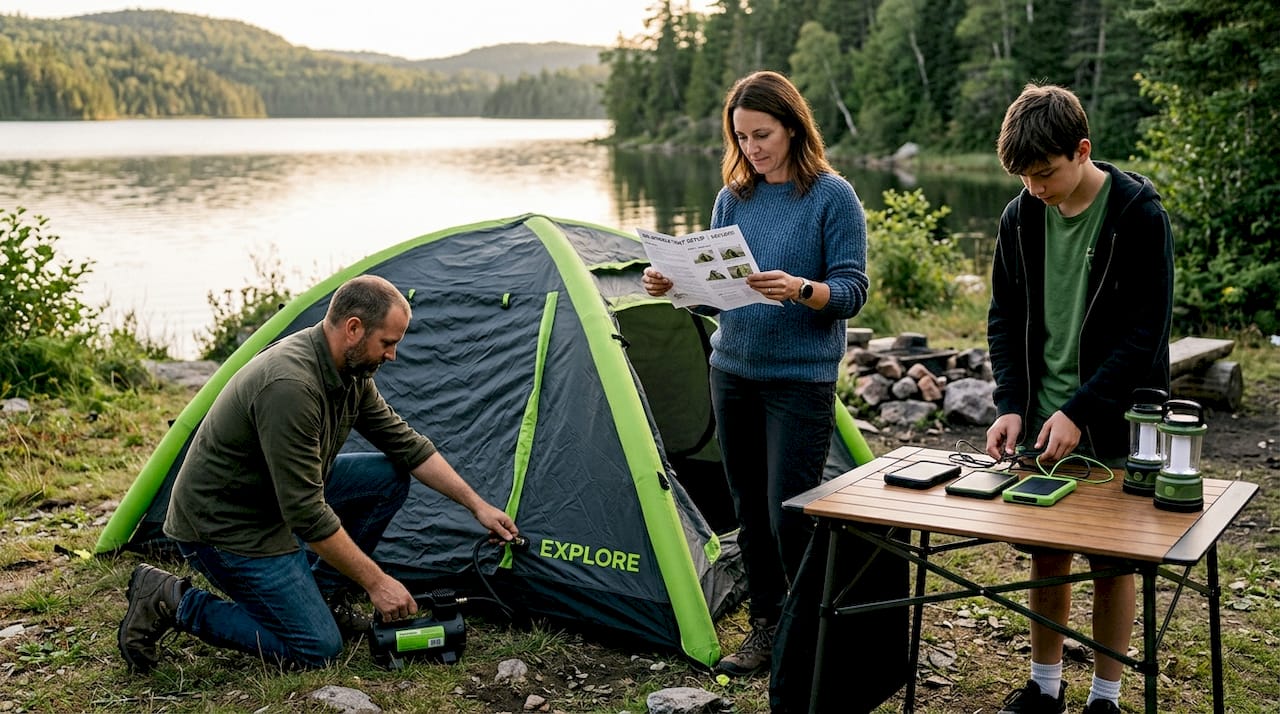
Nothing wastes a camping trip faster than spending the golden evening hours wrestling a tent that came with a 47-step instruction booklet. The shelter category has seen some of the biggest tech leaps of any camping gear segment, and the gains are real and measurable.
Inflatable tents represent the sharpest break from tradition. The Karsten TOW uses pressurized tubes to cut setup below 10 minutes using an included compressor, delivering an igloo-shaped dome that’s 3.5 meters square and 2.25 meters high with 1,200 liters of storage. That’s a genuinely usable space that goes up before your campfire gets going. Compare that to a traditional pole tent, which demands coordinated effort, a flat surface, and usually at least one person who’s read the manual.
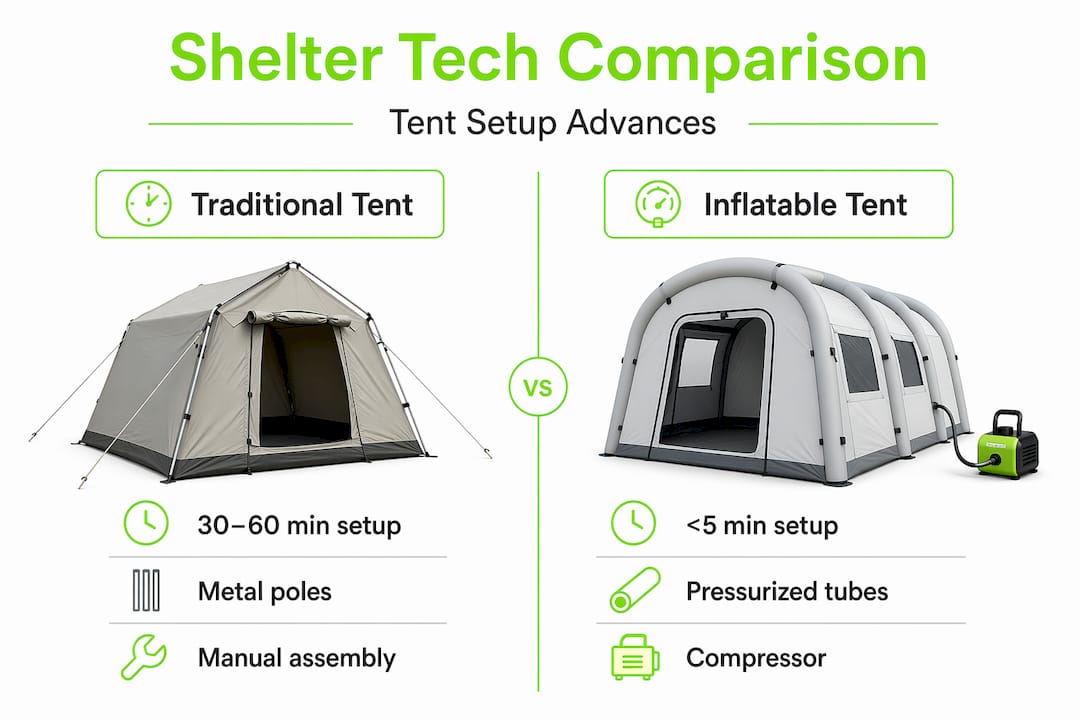
| Feature | Traditional pole tent | Inflatable tent (e.g., Karsten TOW) |
|---|---|---|
| Setup time | 30–60 minutes | Under 10 minutes |
| Tools needed | Poles, pegs, patience | Compressor, pegs |
| Pack size | Bulky, awkward | Compact cylinder |
| Wind resistance | Depends on pole design | High (pressurized frame) |
Vehicle-integrated shelters push the convenience angle even further. The Thule Outset deploys in under one minute and uses 600D polyester ripstop fabric with a rain fly, but here’s where it gets clever: unlike most rooftop tents, it detaches from the vehicle hitch so you can drive off for supplies while camp stays set up. Rooftop tents restrict vehicle mobility as a basic design flaw, and this solves it directly.
Pro Tip: If you’re investing in an inflatable tent, store the compressor where it’s accessible during teardown. Deflation is just as time-sensitive as inflation when you’re packing up in rain.
Every other category of camping convenience tech depends on this one. Get your power situation wrong and your smart lantern, GPS device, heated blanket, and portable espresso maker are just expensive ballast in your pack.
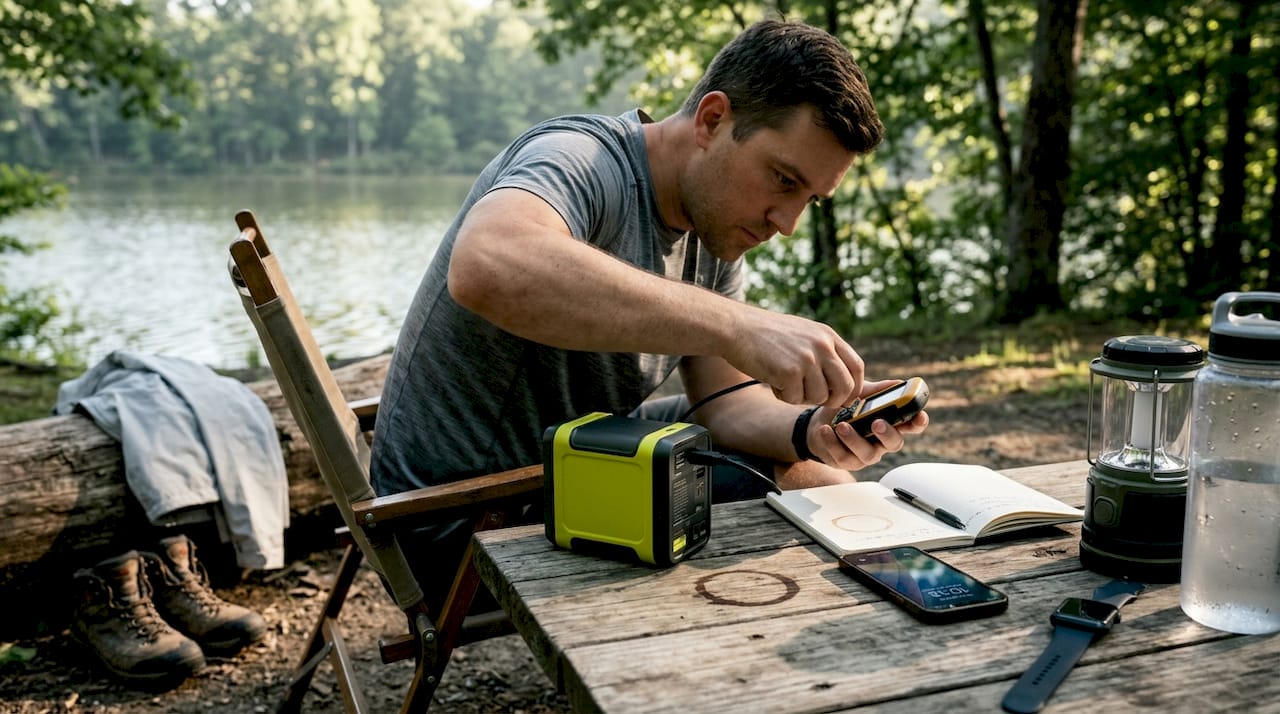
The biggest chemistry shift in off-grid power is the rise of lithium iron phosphate batteries. LiFePO4 batteries last up to 4,000 charge cycles, which is roughly four to five times longer than older lithium-ion chemistries. For a power station you’re going to haul out dozens of times a year, that longevity math matters enormously.
Solar charging quality has also jumped. Maximum Power Point Tracking (MPPT) technology, now standard in better solar generators, achieves energy capture efficiency above 98% and can recharge a power station in three to six hours under good sun. The EcoFlow DELTA 2 paired with compatible solar panels is the go-to example here. It turns an overcast afternoon into a meaningful charge session rather than a wasted one.
Here’s what most guides skip: cold weather is a battery killer.
Pro Tip: For multi-night winter trips, calculate your watt-hour needs for all devices before you buy a power station. Add 30 percent as a cold-weather buffer. Most campers underestimate this by a wide margin.
This is where the fun category of outdoor tech solutions really opens up. The best smart camping gear earns its spot not by being high-tech for its own sake but by solving problems that low-tech gear simply cannot.
Here are four devices that genuinely change the comfort equation:
Hedgehog GO portable dryer. This thing is genuinely impressive. The motor spins at 105,000 RPM generating 96 km/h wind speeds, drying boots, gloves, and even hair in minutes. It weighs 350 grams and runs on 100 to 220 volts worldwide. Wet boots at a remote campsite used to mean a cold, miserable morning. Now it’s a 20-minute fix.
Flextail Max Repeller S. A mosquito repeller that doubles as a power bank is a genuinely smart piece of kit. Its 9,600mAh battery supports 19 hours of camping mode (10-foot protection zone) or 12 hours of outdoor mode (30-foot zone). Having dual protection modes means you can dial in coverage based on whether you’re sitting around a fire or moving through brushy terrain.
Modern LED lanterns. Today’s camp lanterns run 100-plus hours on a single charge, offer tunable warm-to-cool color temperatures, and fold flat for packing. Some double as phone chargers. The atmospheric difference between a decent LED lantern and a cheap battery-burning one is significant on long trips.
Multi-function gear philosophy. The campers who pack lightest and comfortably are almost always the ones who’ve stopped buying single-purpose gadgets. One device that dries boots and hair beats carrying a hair dryer and a boot dryer every single time.
Pro Tip: A compact drying solution for hats and headwear is easy to overlook but makes a real difference after a rainy day on the water or trail. Wet headwear kills warmth fast.
Your smartphone is fine for GPS when you’re 20 minutes from town. Push into genuinely remote territory and its limitations show up fast, and sometimes dangerously.
Smartphones have critical off-grid drawbacks including rapid battery drain in cold, near-invisible screens in bright sunlight, and touchscreen usability issues with wet or gloved hands. Dedicated outdoor navigation devices solve all three at once.
| Factor | Smartphone | Dedicated nav device (e.g., TrailNAV) |
|---|---|---|
| Screen readability in sun | Poor | Excellent (ePaper) |
| Battery life in cold | 2 to 4 hours | All-day with solar top-up |
| Usability with gloves | Difficult | Physical buttons work perfectly |
| Offline maps | App-dependent | Built-in, always available |
| Solar charging | No | MPPT integrated |
The TrailNAV illustrates where dedicated devices are heading. It uses a NEO-M8N GPS chip, QMC5883L magnetometer, a 2.7-inch ePaper display, and MPPT solar charging for genuinely self-sufficient navigation. Physical buttons mean you can operate it wearing thick gloves in a snowstorm. The ePaper screen is readable in direct sunlight. These aren’t minor conveniences. In certain conditions, they’re the difference between confident navigation and a very bad day.
The gear decisions that separate a comfortable, efficient camp from a chaotic one usually happen at home, before you leave. Choosing well means thinking through a few honest criteria before anything goes into your pack.
Start with the portability question. Every piece of compact camping gear you bring should justify its weight and volume independently. If it doesn’t pull its weight in daily use, leave it behind. Nesting cooksets with ceramic non-stick coatings are a great example of this principle applied well. They’re lighter and more compact than conventional cookware while being tougher for camp use.
A few practical criteria to run each piece of tech against:
Optimizing your camping accessory workflow is just as important as the gear itself. Knowing where everything lives in your setup, how to access it fast, and how it all works together is what separates a smooth camp experience from a messy one.
I’ve tested enough camping gadgets to know that the worst trap isn’t buying bad gear. It’s buying too much good gear.
There’s a real seduction to the convenience tech category. Each individual product genuinely works well. But when you add an inflatable tent, a solar generator, a portable dryer, a dedicated GPS, a mosquito repeller, and a collapsible espresso machine to one pack, you’ve created a logistics operation, not a camping trip. I’ve done this. It is not fun.
What I’ve learned is that the best approach is to identify the two or three genuine pain points from your last trip and solve those specifically. Wet boots ruined your last hike? Get the Hedgehog GO. Lost a couple of hours setting up shelter? That’s when the inflatable tent pays for itself. Solved one problem thoroughly beats half-solving five problems.
I’ve also found that tech-forward camping and immersive outdoor experience aren’t in conflict the way people assume. A reliable navigation device doesn’t make the trail less beautiful. A well-lit campsite makes the evening around the fire better, not worse. The outdoor spirit stays intact when tech fades into the background and does its job without demanding attention.
The one thing I’d push back on is the assumption that portability and comfort are trade-offs. The best modern camping tech delivers both. It just requires making deliberate choices rather than grabbing everything that looks good in a review.
— Jonas
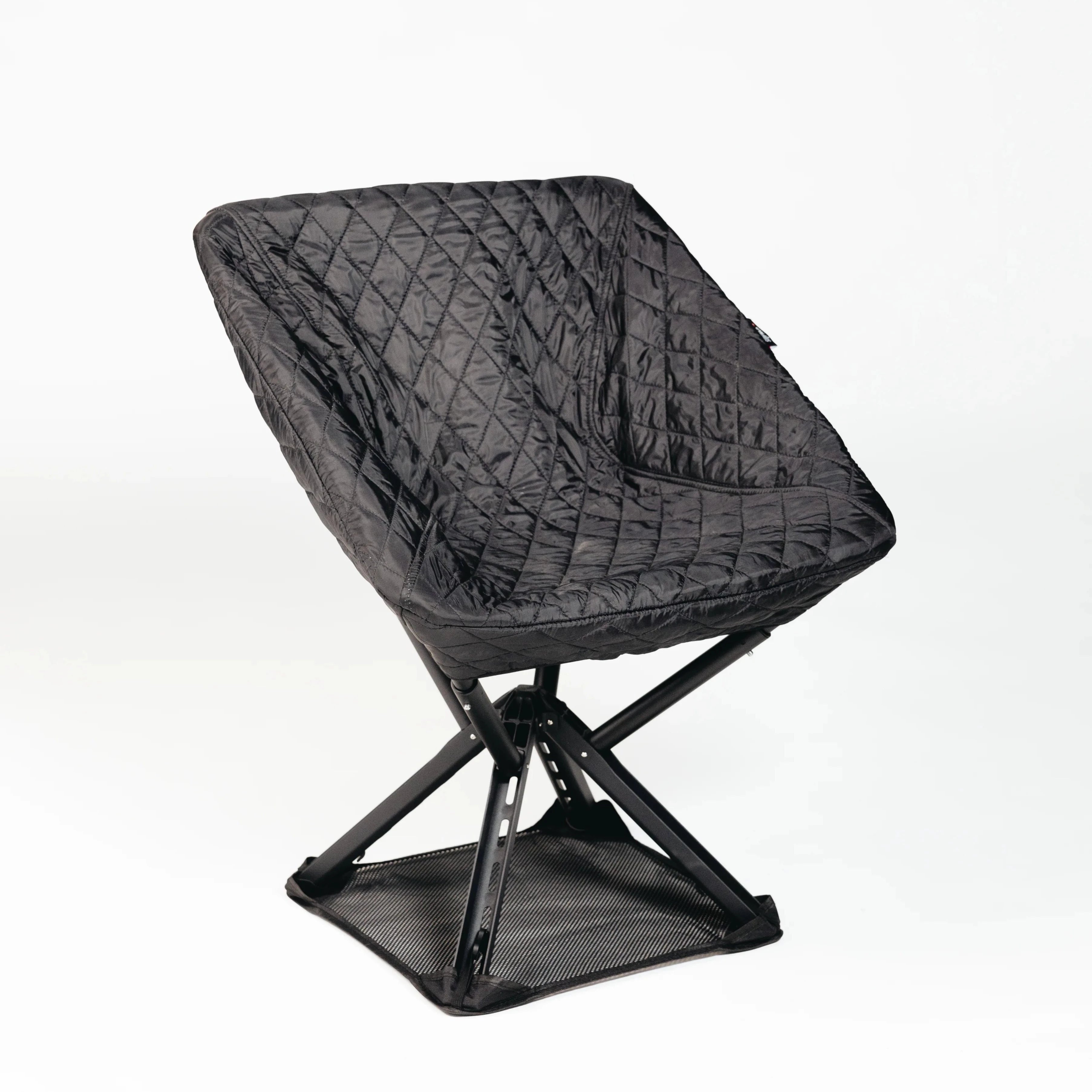
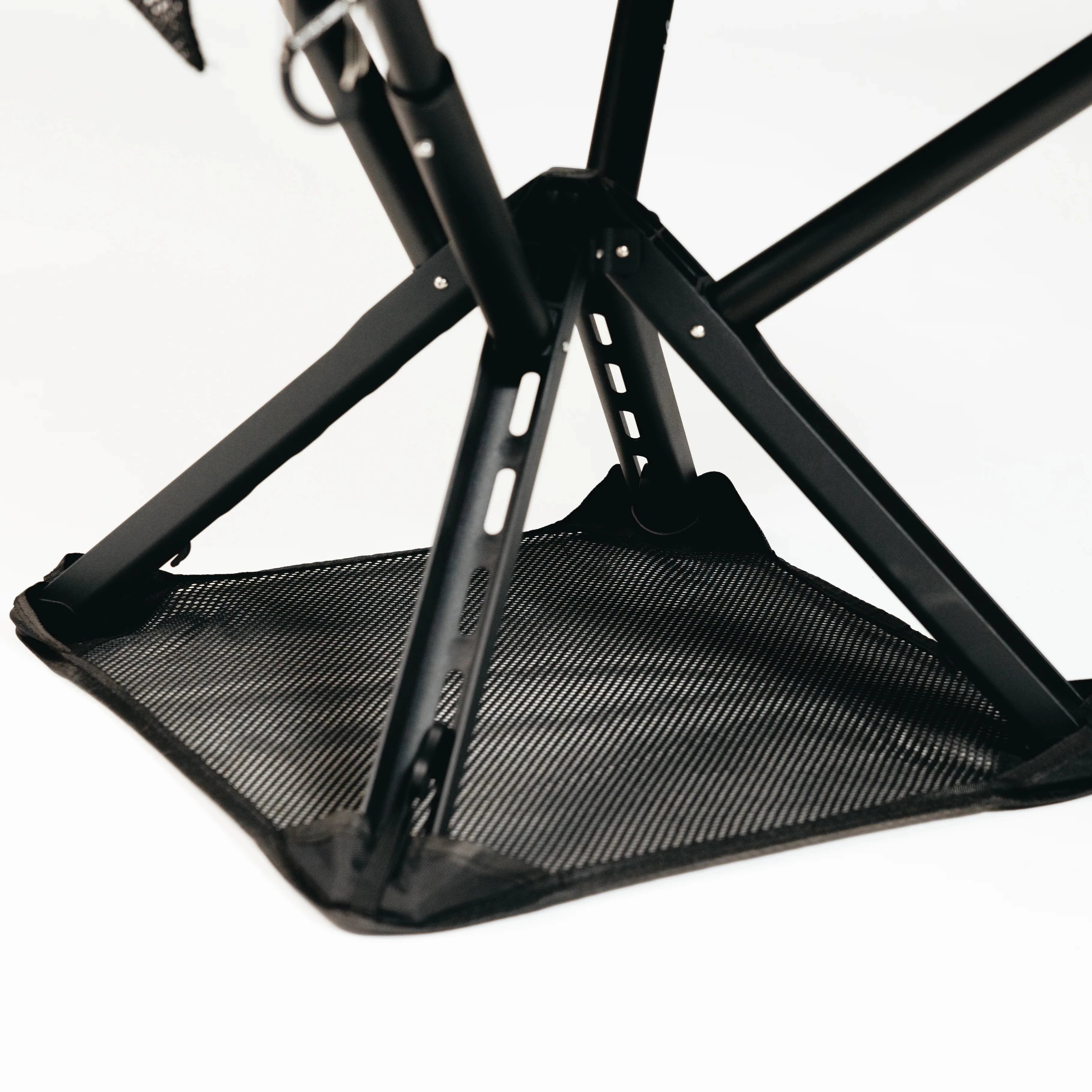
If this explainer has you thinking seriously about how you organize and optimize your outdoor setup, Sitpack is worth a look. Sitpack builds portable, lightweight gear specifically for campers who care about comfort without sacrificing packability. Their foldable seating solutions like the Campster II and Sitpack Zen fit the same philosophy as everything covered here: do more with less, carry less without giving anything up. Sitpack also publishes genuinely useful content on compact camping strategies, gear organization, and portability trade-offs. Explore the full range at sitpack.com and see how the right seating solution rounds out a well-considered outdoor kit.
Camping convenience tech refers to portable, purpose-built gadgets and systems designed to reduce friction in outdoor camping. This includes inflatable tents, solar power stations, navigation devices, and multi-function comfort tools.
LiFePO4 batteries last up to 4,000 charge cycles and handle repeated deep discharges better than older lithium-ion cells, making them far more cost-effective for regular campers who depend on off-grid power.
Yes, for remote or cold conditions. Dedicated devices use ePaper displays readable in sunlight, physical buttons that work with gloves, and solar charging, all of which smartphones cannot match in demanding outdoor environments.
Calculate the total watt-hours your devices consume per day, multiply by your trip length, then add 30 percent as a weather buffer. Match that number to a LiFePO4-based station with MPPT solar charging for the most efficient off-grid setup.
The best smart camping gear solves specific pain points reliably and repeatedly, often replacing multiple single-purpose tools. When one device does three jobs well and weighs less than any one of them alone, the value case is clear.